

How to Optimize Your Product Feed for the Agentic Commerce Era

The way people find products is changing. Beyond the usual keyword search, shoppers are turning to AI tools, images, and shopping assistants to discover what they need. These are experiences around understanding what someone is looking for even if they don’t know the exact words to search for.
As these shopping experiences evolve, product feed quality is one of the most important factors that influence visibility, discoverability, and performance across Google surfaces. Merchants that provide rich, complete, and accurate product data are in a better position to attract more qualified traffic and achieve higher conversion performance.
Key Takeaways
Rich product titles, descriptive product descriptions, and accurate GTINs help Google to understand and index products accurately.
High-quality product images assist in discovery and boost user engagement.
Free shipping, fast shipping, and clear return policies help build trust with shoppers and increase conversion.
Listings with sale prices, promotions, and product ratings get more clicks and conversions.
Optimizing your feed can bring you measurable performance gains such as an improved conversion value, conversion rate, and overall campaign efficiency.
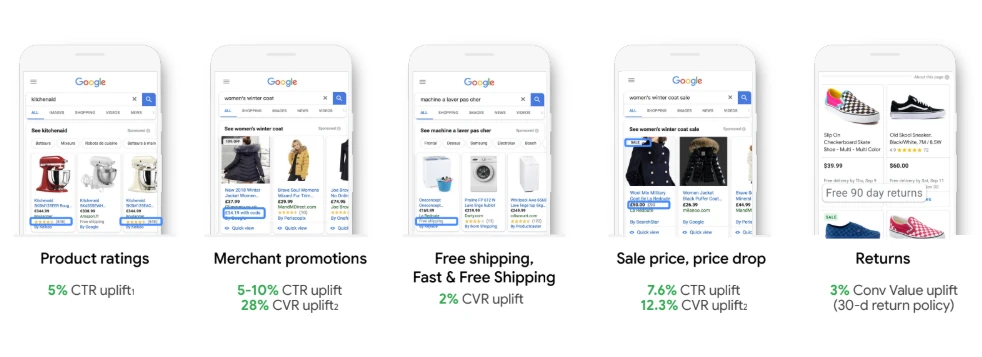
Key features that improve Google Shopping performance
Why Feeding Quality Matters More Than Ever
Agentic commerce is shifting product alignment with consumer intent. The modern shopping experience is built on structured product data. It powers search, shopping and AI-powered discovery platforms that find, categorize and surface products. Having complete and rich product information helps Google’s systems better understand your catalog and serve relevant products to more complex customer searches.
Merchants who invest in feed quality often see the benefits reflected in better performance indicators. According to Google stats: core feed best practices resulted in:
Conversion value increased by 4.5%
+5.0% increase in converted orders
Sales and promotions badging can increase conversion rate by +28.0% or more.
1. Improve Your Product Data
Product data is the foundation of a successful Google Merchant Center feed. Accurately describe your products so that Google Ads systems can more easily match your products to relevant customer searches.
1.1 Optimize product titles
Product titles should be relevant to shopper search behavior and include meaningful information to help identify the product. Make the title at least 30 characters long to help with discoverability and matching search queries.
1.2. Extend product descriptions
Descriptions give search engines and artificial intelligence systems more context to understand product features, benefits, and use cases. Providing descriptions of over 500 characters can be useful for matching products to complex search intent.
1.3 Add GTIN
Global Trade Item Numbers (GTIN) are some of the most powerful identifiers of products. Include GTINs where available to help Google correctly identify products and to help with exact product indexing.
1.4 Why This Matters?
High-quality text attributes enable AI-powered shopping systems to surface products better when users search using natural language or conversational queries.
2. Enhance Your Visual Assets
Images are critical for a shopper’s first impression of a product. High-quality visual assets can drive click-through rates and help visual search technologies better understand product content.
2.1 Use high-resolution images
Make sure your main product images are at least 1500×1500 pixels so they work well across shopping placements.
2.2 Add Additional Product Images
Products should have at least 3 additional images showing:
Different viewing angles
Product features
Product usage scenarios
Lifestyle contexts
2.3 Include Lifestyle Photography
Lifestyle images help customers visualize products in real-world environments and provide richer context for visual discovery systems.
2.4 Stay Ahead of Compliance Requirements
Products with images below 500×500 pixels face future disapproval risks, making image quality a critical priority for merchants.
3. Highlight Convenience and Trust Signals
Consumers increasingly value convenience alongside price. Merchants who clearly communicate shipping and return information create stronger trust signals and improve conversion potential.
3.1 Promote Free Shipping
Displaying free shipping eligibility prominently can help improve conversion rates and increase purchase intent.
3.2 Specify Shipping Speed
By providing delivery timelines, you qualify for valuable shopping annotations, such as fast shipping badges, that highlight your products in competitive categories.
3.3 Showcase Return Policies
Clear return information reduces purchase hesitation and builds consumer confidence. Merchants should explicitly state return periods and policy details within their product data and website experience.
4. Leverage Differentiators That Increase Visibility
Once product data and logistics information are optimized, merchants should focus on differentiators that improve listing performance and encourage more clicks.
4.1 Use Sale Price Annotations
Submitting both the original price and sale price allows Google to display discount information directly within shopping listings. Sale pricing can improve click-through rates and conversion rates by clearly communicating value to shoppers.
4.2 Collect Product Reviews
Ratings and reviews are a form of social proof. Product review feeds and star ratings can increase shopper confidence and drive more engagement with listings.
4.3 Activate Promotions
Promotions, discount codes, and promotional badges on merchants can have a huge impact on visibility and performance by making offers more attractive in competitive search environments.
The competitive advantage of acting today
Merchants who maximize their feeds today will be best positioned for the future of AI-powered commerce. Enhanced product data enables:
Improved discovery on Google surfaces
Enhanced visual indexing capabilities
More accurate matching of products
Increased engagement rates
Improved conversion performance
Feed quality is more than a technical requirement in an era where agentic commerce is reshaping the online shopping experience. It is becoming a strategic growth lever that has a direct impact on visibility, traffic quality and revenue generation. Merchants who invest in rich product data, strong visual assets, shipping and return policies and promotional enhancements will be best placed to thrive in the next generation of digital commerce.
However, maintaining a fully optimized product feed can be complex and time-consuming. That's where Delupe can help. As one of Europe's leading Google Shopping CSS partner and Microsoft Bing Advertising experts, Delupe works closely with merchants to identify feed gaps, improve product data quality, resolve feed issues, optimize product imagery, and implement best practices that maximize visibility across Google Shopping and AI-powered commerce experiences.
Our team continuously monitors feed health and performance to ensure product catalogs remain competitive as shopping technologies evolve. From enhancing titles, descriptions, and GTIN coverage to implementing promotions, shipping attributes, and trust signals, we help merchants unlock the full potential of their product feeds.
By combining industry-leading feed optimization expertise with performance-driven campaign management, Delupe enables merchants to increase discoverability, drive higher-quality traffic, improve conversion performance, and ultimately generate more revenue.
The merchants that invest in feed quality today will be the ones best positioned to win tomorrow's AI-powered shopping landscape. With Delupe as your partner, feed optimization becomes a competitive advantage rather than a technical challenge.
Contact Delupe to discuss your product feed and Google Shopping goals.